Tickets
 Shop
Shop









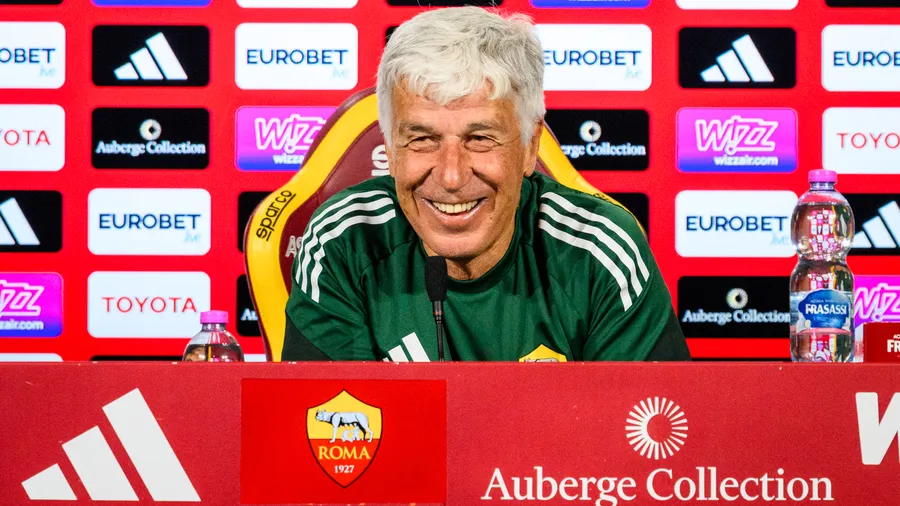
Read below what the boss had to say.
How is the team looking going into this last league game and how is Manu Kone especially?
“Kone has recovered and he trained all week with us. He still has a slight niggle – he's not 100% – but he's definitely available. I don't know if he'll start or be on the bench but he's available for selection. The rest of the team is suffering a little from the heat and the temperature. We must make sure we're ready at the right time tomorrow evening because it's a very important game.”
Regardless of what happens tomorrow, what are you happiest with about your first year at Roma?
“Generally at this time of the year you take stock of what you've done over the season, but right now I find it very hard to think about that because we're totally focused on Verona. It would be a great achievement for the club, the city, the fans, the team and the players, and it's something that hasn't been done for a few years. It all depends on us. We don't need to rely on others. We'll do our final analysis tomorrow, after the game. Today there's too much focus and tension surrounding this match.”
What are the main dangers and the risks you mustn't take against Hellas Verona? How are the senators of the team doing mentally?
“The whole team is aware of how important this game is for everyone. It's felt like an incredibly long week but this is also the finish line of a season in which the team has always been united and compact. They've always responded well and shown great application and desire.”
Where do you think you've had the biggest impact inside Trigoria?
“It's been anything but an easy year. I've tried to introduce my working methods, which are what have helped me throughout my career. I've been fortunate enough that the players have bought into my ideas and that's probably the secret behind the results we've obtained – the 70 points so far. We hit it off and worked towards the same goals day after day. It's been almost 11 months. Now the most important thing is capping it off with a result that didn't even seem to be within reach at a certain point. Maybe that's why there's so much expectation because tomorrow's game is down to us. Football can be cruel because the 90 minutes count for so much. Bad results are remembered but you have to look at how many times Roma have won key matches to achieve targets.”
After the Bologna game, you said 'Don't rule Roma out' of the race for the top four. Did you really believe that or was it a way to motivate the team?
“I knew we'd had some excellent games, that the team had improved and we were scoring more goals than earlier in the season. When you score goals, you can win games and turn them around, as we did at Parma for example. The team had grown in confidence and we were creating more openings. I was sure that we could have a strong finish, as we've done till now. Of course it depended on the teams ahead of us too, but that takes nothing away from our own results.”
Considering the difficulties you've had throughout the season, would getting into the Champions League be one of your greatest career achievements?
“I don't want to rank anything. Every achievement is special when you succeed. Some teams set out to win the league, others to stay up. Everyone has a target and if they reach it, they're happy. One is not worth more than another. It's true that this year we set ourselves a target that was above what we were asked for, and that was the driving force that made us keep going, never let up, and try to go beyond our limits. It was a target that we all felt, that the fans wanted, and we wanted to make them happy.
Could having Ryan Friedkin in Trigoria be a positive factor next year?
“It's a big commitment that I've tried to develop as much as possible, especially in this recent period, because having the owners around is crucial. It helps to avoid unpleasant situations in the workplace, it gives strength to the team and the club and means you get clear answers more quickly than before. I hope a good result tomorrow can help Roma to become more compact, reinforce plans and ideas, even with mistakes, and work towards a common goal. Having the owners around more would certainly help with all that.”
Will Matias Soule start in a front three with Paulo Dybala and Donyell Malen? Are you happy with his development and how much margin for improvement do you see in him?
“He went through a very good spell when he was getting goals and assists, then he was sidelined for a long time, around 50 days, which reduced his impact on the team. Last year he played at wing-back. This year his qualities have made him a more attacking player. The most important thing is that he's fit. He's still young and once he's fully recovered from his groin problem he can become an even better player.”
Why is it important for a team like Roma to get into the Champions League?
“The most important reason, for the clubs, is the financial aspect. There's a huge difference between being in it and not being in it. Those finances mean you can do more in the transfer market and attract players from abroad, because a Roma team in the Champions League has a lot of appeal. The players benefit from it too as they improve by playing in the Champions League. There's also the emotional aspect: it's immensely satisfying to know you're part of Europe's elite and one of the top four Italian clubs.”
Do you feel any self-satisfaction for what you've done and what you're doing on a personal level?
“It's gratifying for everyone, especially as the season could have been much more difficult. We're happy with how we've dealt with it and how we've reached this last match. The last game matters because ultimately it's the final result that is remembered. Those who win celebrate, and those who don't talk about it. We want to avoid talking about how it went and instead put down a marker.”
In preparing for this match, have you focused on Verona's counter-attacking play?
“It's true that Verona play a pressing game and play on the break a lot but Roma have won lots of games against smaller teams in which we were hit on the counter-attack but did lots of good things too. We need to focus on everything. We know we're up against a team that's already relegated but they've had some excellent games, especially recently. Our target is not easy and it's not done yet. To achieve it we need to play well for 90 minutes.”
If you win this match, you will equal Nils Liedholm's record as the coach with the fifth-most points in Serie A. What does it mean to be mentioned in the same breath as someone like that?
“For a start, it means I've had a lot of seasons! I wouldn't say it's an enviable record – if I could start again, I might play a bit less – but it's nice to be compared to coaches of Liedholm's calibre. It's one for the statistics, and maybe a funny coincidence. Achieving such a record in a situation like this would be even better.”
During the season you've often spoken about the togetherness of the team. Was there a specific moment when you saw the strength of that bond?
“I'd say after every game we lost. And there were quite a few. When you lose, it often causes problems and controversy, but never within the team. They've always shown their determination to bounce back, their professionalism, and their desire to move on and look forward.”
Is there anything you regret or a choice you wouldn't make again during this first year at Roma?
“Everything was done in good faith. When you work in that way, sometimes you make mistakes but you learn from them and you go again; you learn something so that you can do better next time. Mistakes are not a failure – they're a learning opportunity. I believe that even when we've had bad situations, we've always been able to do something better afterwards.”
Would you have taken this result back on 23 August, before the home game against Bologna? I mean, being in fourth place going into the last game, knowing it depends only on Roma.
“Back then I was only thinking about the Bologna match – our first after the training camp and pre-season – so that I could see what we were capable of. I don't set targets beforehand. First you have to try things, you start playing, understand how good you are and then you realise that you can do certain things, that you can do more than other teams. It's a process you build a bit at a time.”
How big a difference does it make to have a goalkeeper like Mile Svilar who saves 77% of shots?
“Well, there once was a man who said, 'Give me a goalkeeper who can save and a striker who can score and I'll figure out the rest,' and he was an amazing coach. Now I have both and you can tell!”

.





..