Tickets
 Shop
Shop








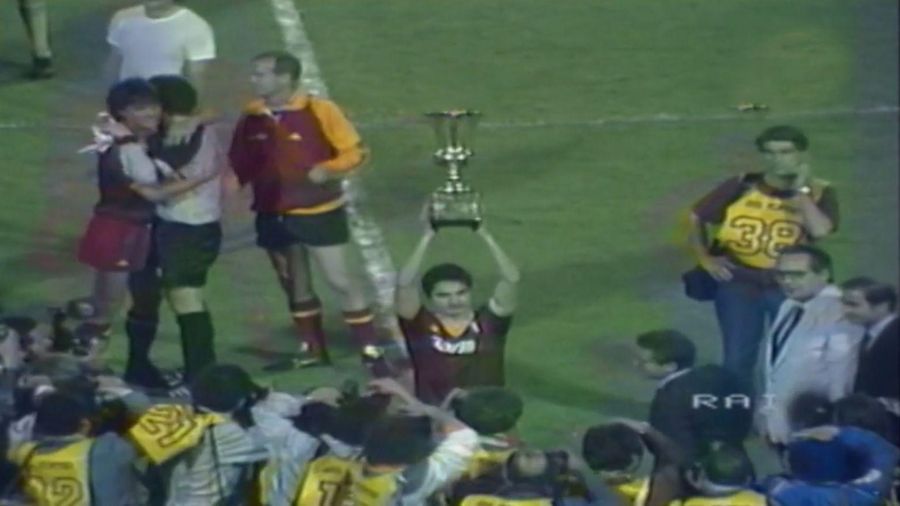
Roma v Verona, 26 June 1984, the return leg of the Coppa Italia final.
Agostino Di Bartolomei's last game for Roma.
Nils Liedholm's last game before returning to AC Milan, having introduced a zonal marking system and orchestrated five dream years.
It was our fifth Coppa Italia, lifted by the captain with two hands then held with one before going on that final lap of honour which finished in front of the Sud.
It was all too little for that Roma – a team that had given everything and so nearly won the European Cup. Way too little.
Now the dream was gone. Roma was leaving him. He was leaving us.
Roma v Verona had been his last league game for Roma in May, before the final against Liverpool. Roma v Verona also ended up being his last-ever appearance for the club.
Of the many banners on display that evening one read: “Agostino, this is not goodbye. So long, champ.”
Sadly the Sud got it wrong that time, though it was only natural on such an occasion.
How could you lift a cup when you'd lost The Cup?
How could you say goodbye forever to your captain?
That day the Curva Sud managed to get a letter to Agostino Di Bartolomei via Giuseppe Giannini. The letter – written by Ludovica, a girl from the Curva – was published in Il Corriere dello Sport. Here's an extract:
It's hard to contemplate that this is the day we say goodbye. [...] How can we possibly imagine you coming out of the tunnel at the Olimpico wearing another shirt? Dear Agostino, we'd like to cry in your face but would that be right? Perhaps this is the best way – saying goodbye with a group letter. [...] We've admired you so much, dear Ago. We've seen the sort of person you are and appreciated you. The way you don't always try to be the “star”. Your grit, selflessness and desire. [...] That will always help us. [...] You would wave to us raising your arm, slightly timidly but full of gratitude [...] without making a scene, just being sincere with your fans. You were a maestro to us all, on the pitch and in life. You taught us to fight the right way. You made us feel proud to be Roman and Romanisti. You embodied the dream of all young Romans. [...] Some people might say that players come and go but Roma remains. Maybe so, but you're not like the others to us. [...] You're part of us. [...] It seems silly for us to wish you well with your new team. What would be the point? Perhaps we can't quite believe it yet, or we don't want to believe it – it's beyond us. [...] Dear Ago, please score for us today. It will help us to find courage. We want to see your arms raised to the sky below the Curva. We want to see you smile in front of us. We'll all laugh and cry because we'll have had a great man who cared about us.
Commando Ultrà Curva Sud
Ago didn't score that night and nor did he smile. When he lifted the cup it looked more like a sneer.
It was time for him to say goodbye. 90 minutes and a trophy were just prolonging the inevitable.
More than a final, it was the prelude to The End.
The match itself was rather boring, fairly tense but not particularly difficult. Roma went ahead through a Mauro Ferroni own goal in the 28th minute and after the break – with the first leg having finished 1-1 – they managed the lead comfortably thanks to the sending-off of Maurizio Iorio, a former Roma man about to return.
The most curious incident of the match occurred ten minutes from the end when Paulo Roberto Falcao openly tried to stop Roberto Pruzzo being replaced by Francesco Vincenzi – Liedholm's third substitution.
The next day the newspapers were critical of this act of insubordination but failed to see the egg of Columbus: Falcao was already taking the place of Liedholm, who had decided to leave. Falcao had always been a coach on the pitch.
“I'm sorry but I've made a choice. One story ends and another begins,” said Liddas, whose departure was less wrenching than the one Agostino had to suffer.
Ago was no longer part of the club's plans. He was no longer part of Roma. He left and slipped away via the tunnel.
That 1-0 win over Verona, our fifth Coppa Italia, went down in history as Ago's last game for Roma – a game that should never have had to happen. Or be played.
When Agostino came onto the pitch, he turned, as he always did, towards the Sud and read that banner which will always be remembered: “They can take Roma away from you but not your Curva.”
I've always loved that banner but I now know that was wrong too. Because nobody will ever be able to take Roma away from Ago.





.





..